SEO Services in Australia: Cost, Timeline & Results (2027 Guide)


Published On: October 24, 2026

Finding SEO services Australia businesses can rely on is easy. Finding ones that actually bring you customers is the hard part. Most business owners we speak to tell the same story: they paid for SEO, received a monthly PDF full of impressions and “keyword movement”, and still couldn’t name one customer who found them on Google. Others haven’t started at all, because every quote they’ve collected sits somewhere between $500 and $10,000 a month and nobody has explained why.
This guide is the plain-English version. It covers what SEO services Australia agencies charge as you plan for 2027, how long results really take, what Google changed during 2026 that affects your budget, and how to tell a working campaign from an expensive report. It’s written for owners and marketing managers in Sydney, Melbourne, Brisbane, Perth and the regional centres in between, whether you run a clinic, a trades business, a real estate agency or an online shop.
What SEO has to deliver (and what it doesn’t)
SEO is the work of making your website easy for Google to crawl, understand, and trust, so it appears when people search for what you sell. That’s the definition. The measure of success is different: it’s enquiries. Calls, quote requests, bookings, orders. That’s the test for any SEO services Australia business should pay for.
Rankings are only a means to that end. Picture an electrician in Brisbane who ranks third for “emergency electrician” but has a contact form that breaks on mobile and no call tracking. That business is paying for traffic that goes nowhere, and nobody will know because the report only shows positions.
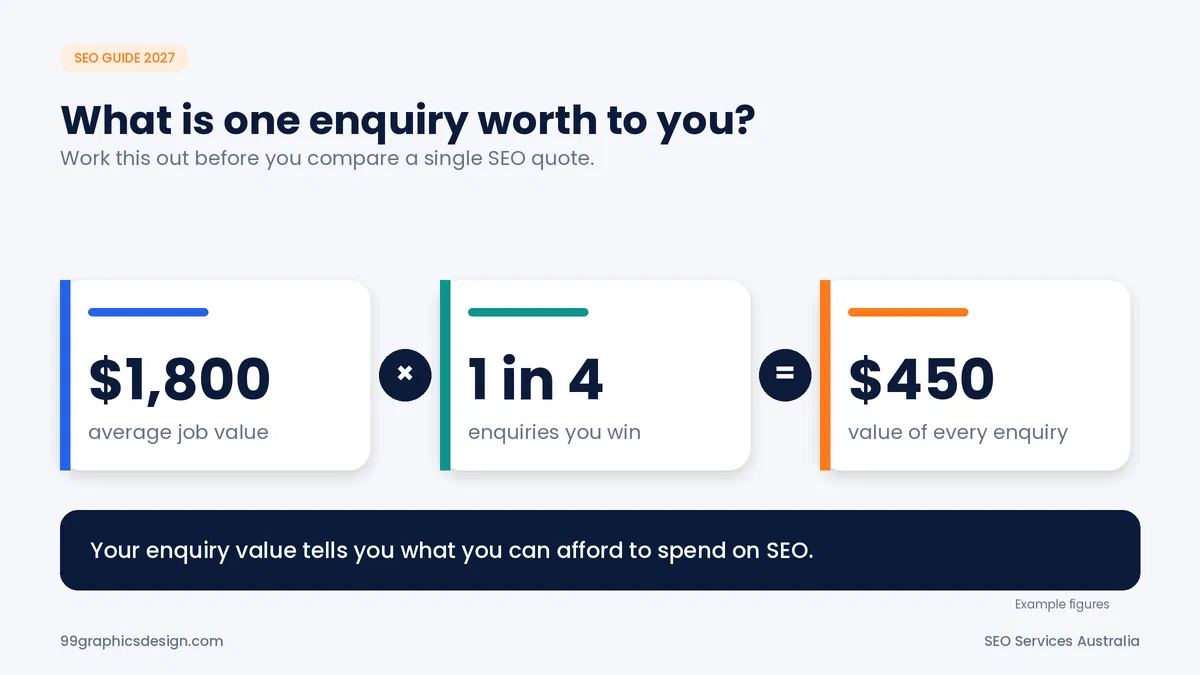
Before you compare any quotes, work out what a lead is worth to you. Say your average job is $1,800 and you win one in four enquiries. Each enquiry is then worth about $450. That single number tells you what you can sensibly spend far better than any “industry average” you’ll read online.
What Google changed in 2026, and why it affects your budget
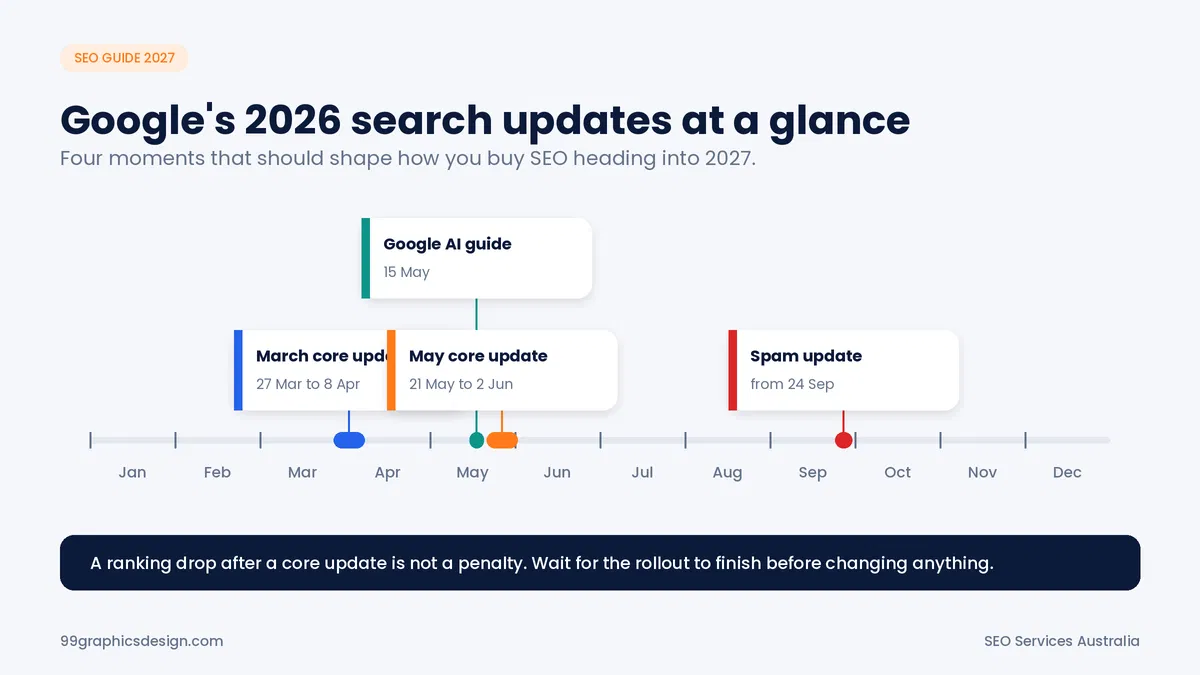
You don’t need to follow every algorithm headline, but four developments from this year should shape how you buy SEO services Australia-wide heading into 2027.
Two broad core updates
Google rolled out a core update from 27 March to 8 April and another from 21 May to 2 June. Google describes these as regular updates meant to surface relevant, satisfying content, and a ranking drop after one doesn’t mean you broke a rule. Its core updates documentation advises against quick fixes and rushed changes. Wait until a rollout finishes, give it about a week, then compare your data in Search Console. If an agency panics and rewrites your whole site mid-update, that’s a warning sign.
Tighter spam enforcement
Google’s spam policies target scaled content abuse, which means publishing lots of pages mainly to manipulate rankings rather than help people. That applies whether the pages come from software, writers or a mix of both. A further spam update began in late September. In practical terms, an agency offering 200 near-identical suburb pages for a flat fee is selling you risk.
AI search is still SEO
In May, Google published an official guide to optimising for generative AI features, which covers AI Overviews and AI Mode. The headline: these features are built on the same ranking and quality systems as normal search. There’s no separate index, and you don’t need special markup or a special file. A page has to be indexed and eligible to show with a snippet, and Google says original, genuinely useful content matters more than any other tactic in the guide.
More searches end without a click
For general “what is” questions, AI answers now satisfy a lot of people on the results page. Searches with buying or local intent, such as “plumber near me” or “SEO packages for a dental clinic”, still send calls, direction requests and form fills. For most Australian service businesses, that’s where the money is.
What does this mean for your budget? Pay for original content with real expertise behind it, a technically healthy site, and a reputation that holds up across the web. Be sceptical of separate “AI SEO” line items with new acronyms. If an agency adds one, ask exactly what work it covers that normal SEO doesn’t.
How much does SEO cost in Australia?
SEO services Australia providers sell are priced across a wide band because the work varies so much. Search for “SEO cost Australia,” and you’ll see everything from $500 to $10,000 a month, and the gap is real. Published 2026 pricing guides from Australian agencies put monthly retainers anywhere from about $1,000 to $10,000 or more. Most small businesses land between $1,500 and $3,000, and mid-sized companies between $3,000 and $5,000. One agency’s client data puts the average Sydney campaign near $3,700 and Melbourne near $4,060 a month, excluding GST. Independent consultants typically charge $150 to $300 an hour.
Treat the table below as a planning guide for SEO services Australia budgets rather than a quote.
| Business type | Typical monthly range (AUD, ex GST) | What it usually covers |
|---|---|---|
| Single-location local business (tradie, clinic, café) | $1,000 – $3,000 | Google Business Profile, local pages, citations, reviews, a few content pieces |
| Growing small or mid-sized business | $2,500 – $5,000 | The above plus service-page content, technical fixes, link earning |
| Ecommerce store | $3,000 – $6,000+ | Category and product optimisation, technical SEO, content, conversion work |
| Multi-location or national brand | $5,000 – $10,000+ | Location strategy, digital PR, detailed reporting |
Four ways agencies price SEO
Monthly retainers are the most common because SEO compounds: technical health, content, and authority all need ongoing work. Project pricing suits a one-off audit or a site migration. Hourly rates fit short consulting jobs. Performance-based pricing exists but is rare, and the fine print matters.
Why quotes for the same business differ
If you’re trying to understand why two quotes for the same business differ by $2,000, look at these factors:
- Competition. Ranking for “personal injury lawyer Sydney” costs far more than ranking for “mobile mechanic Ballarat”.
- Site condition. A slow site with duplicate pages needs repair before growth work can begin.
- Content volume. Writing, editing, photography, and design all cost money, and good content is the biggest line item.
- Geographic scope. One suburb is one job. Eight states and territories is another.
- Who does the work. A freelancer, a boutique agency, and a large team have different overheads and different capacity.
What cheap SEO really buys
On the cheap end, SEO services Australia agencies sell for under about $800 a month are usually a templated checklist run across dozens of clients. That can fix the basics, but it rarely builds the authority that wins competitive searches. If your budget is tight, a focused local plan from a smaller scope beats a thin national one.
What SEO services Australia agencies include in a decent package

When you compare SEO packages Australia agencies advertise, ignore the tier names and look at the deliverables. A solid monthly engagement normally includes:
- An audit and tracking setup. GA4 and Search Console connected, calls and form submissions tracked as conversions, so every later decision rests on real numbers.
- Technical fixes. Crawl errors, page speed, mobile usability, indexation, duplicate content, structured data where it genuinely applies.
- Keyword and page mapping. Each service or product gets a page that matches a search intent, rather than five pages competing for one phrase.
- Content. New and improved pages written by someone who understands your trade. Your own photos, prices, process and local detail beat generic copy every time.
- Local work. Google Business Profile management, citations, review requests and suburb-level relevance.
- Authority building. Earning mentions and links from industry bodies, suppliers, local media and partners. Not buying them.
- Reporting you can read. Leads, cost per lead, and revenue influenced, with rankings as supporting detail.
If a proposal is vague about items one and seven, you’ll struggle to prove the investment is working.
What a good monthly report looks like
A useful monthly report fits on one page. It shows organic enquiries (calls, forms, bookings) against last month and last year, the pages that produced them, what was done this month, and what’s planned next. Rankings and traffic sit underneath as context. If the first thing you see is a wall of keyword positions, the agency is reporting activity, not outcomes. Ask them to start with the number that pays your bills, then work backwards from there.
How long does SEO take?
Anyone who gives you a single number is guessing. A realistic pattern for SEO services Australia small businesses buy, with a reasonably healthy website, looks like this:
- Months 1 to 2: foundations. Tracking, technical repairs, page planning, Google Business Profile clean-up. You won’t see much traffic change yet, and that’s normal.
- Months 3 to 4: early movement on lower-competition and local terms. Impressions climb, and some pages start reaching page one.
- Months 4 to 6: the first reliable lift in enquiries, provided the pages that rank can actually convert visitors.
- Months 6 to 12: compounding growth. Content published earlier builds authority, and cost per lead usually starts to fall.
New domains take longer. Highly contested searches in law, finance, and health can take well over a year. And if a core update lands during your campaign, expect a wobble before things settle.
Be wary of a promise of page one in 30 days. Either the target keywords are so obscure they’ll never bring customers, or the plan relies on tactics Google’s spam policies were written to catch.
Local SEO Australia: how to win the map results
For anyone serving customers in a specific area, local SEO Australia-wide is usually the fastest route to leads, because the map results at the top of the page sit in front of people ready to call.
Get your Google Business Profile right
Google Business Profile Australia setup comes down to accuracy. Use your real trading name exactly as it appears on your signage and website, since adding keywords to the name can get a profile suspended. Pick the right primary category, list services, set honest hours, and upload recent photos of your own work. If you travel to customers and don’t have a shopfront, set a service area and hide your address. Google’s guidelines for representing your business are worth reading once, in full.
Where small businesses win
This is also where small business SEO Australia owners can punch above their weight. A local shop or trade can outrank a national chain for a suburb-level search, because Google weighs proximity and relevance alongside brand size.
Keep your details consistent
Your name, address, and phone number should match across your site, your profile, and directories such as Yellow Pages, True Local, and Hotfrog, along with any industry body listings.
Earn reviews steadily
Ask every happy customer, reply to every review, and never buy them. A steady trickle of genuine reviews looks far better to both Google and customers than fifty arriving in one week.
Build suburb pages carefully
A page for each area you serve can work well, but only if each one carries something specific: jobs you’ve done there, local council or suburb quirks, real photos, a genuine testimonial. Swapping the suburb name in an otherwise identical page is exactly what the spam policies describe.
Choose your domain sensibly
A .com.au is a clear local signal, but plenty of Australian businesses rank well on a .com. Don’t move a working site just for the extension.
One more point on location. You’ll find plenty of agencies if you search for “SEO agency Sydney” or “SEO agency Melbourne”, and being in the same postcode as your provider is a nice-to-have, not a requirement. What matters is that they understand Australian search behaviour, price in AUD and GST, know how Australians phrase searches (“tradie”, “chemist”, “servo”) and can show results in your market.
Where to put your budget heading into 2027
If you’re deciding how to split a limited SEO services Australia budget, this is the order we’d consider:
- Pages that match buying intent. Service pages, location pages and product categories come before blog posts.
- Original, experienced content. Real examples, your own data and photography, honest pricing guidance. Google’s own guide says unique, non-commodity content has the biggest long-term effect, including in AI features.
- A fast, stable website. If your site is clunky on a phone, fix that before paying for more traffic. A well-built website supports everything else on this list.
- Reputation across the web. Google’s guide notes that AI features reflect what’s said about brands on other sites, forums, and video. Reviews, mentions, and consistent details count.
- Conversion work. If 100 visitors produce one enquiry, doubling traffic is the expensive route. Conversion rate optimisation often returns more per dollar. The usual culprits are slow pages, weak calls to action, and forms that break on mobile.
Seven questions to ask before you sign
Use these questions in every sales call for SEO services Australia agencies pitch.
- Who will actually work on my account, and how many other accounts do they handle?
- Will I have admin access to Google Analytics, Search Console, and my Business Profile from day one, and will they remain mine if we part ways?
- What does month one look like, specifically?
- How will you tie your work to enquiries and revenue, not just rankings?
- How do you create content, and who with real industry knowledge reviews it?
- Where do your links come from?
- What’s the exit process, and is there a lock-in contract?
Red flags: a guaranteed number one ranking, mass-produced pages, link packages with prices per link, refusal to share reports or access, and reports that never mention leads.
How 99Graphics Design approaches SEO

99Graphics Design is a web design, development, and digital marketing company headquartered in Kolkata, with an office in New York and a team of more than 70 people. Because the same team builds websites and runs search campaigns, technical fixes don’t wait in a queue between a developer and an agency. If your audit shows a slow template or a broken checkout, the people reporting it can also repair it, whether your site runs on WordPress, Shopify, or another platform.
We work remotely with international clients, and our client list includes Australian businesses such as All Day Plumbing. Our SEO services Australia work starts with an audit of your site, tracking, and competitors, and moves into a plan you can follow without a glossary. For online shops, we run a dedicated ecommerce SEO service, and our content marketing team writes the pages that bring buyers rather than browsers. If you work in property, we’ve also built a real estate solution with listings and enquiry handling in mind.
When you assess any provider of SEO services Australia businesses can hire, including us, judge them on the same things: access, evidence, and clarity about what you’re paying for.
Ready for a straight answer?
If you’d like a clear view of what your site needs and what it would cost, talk to the team at 99Graphics Design about SEO services Australian businesses need. Book a free consultation or send us your website details, and we’ll tell you where you stand, even if the honest advice is to fix a few basics yourself first.
FAQs (SEO Optimised for Featured Snippets)
Can I do SEO myself?
For a small local business, yes, up to a point. Claiming and completing your Business Profile, collecting reviews, fixing obvious website problems, and writing helpful service pages are all achievable in-house. A specialist becomes worthwhile when competition is high, your site has technical issues, or your time is worth more than the fee.
Will AI Overviews take all my traffic?
Not for local and buying searches, where people still need to call, visit, or order. Informational traffic is more exposed. The safest response is to publish content that adds something an AI summary can't: your own experience, your own numbers and your own photos.
How do I know if my SEO is working?
You should see more enquiries from organic search in your tracking, more pages earning impressions in Search Console, and a rising share of calls and forms coming from search. If you only see keyword positions, ask for more.
Should I sign a 12-month contract?
Be cautious. SEO agencies in Australia often push 12 months, but SEO needs time to show results, so a three- or six-month minimum is reasonable. A long lock-in with no performance review points is not.

Ready for
Digital Transformation?